
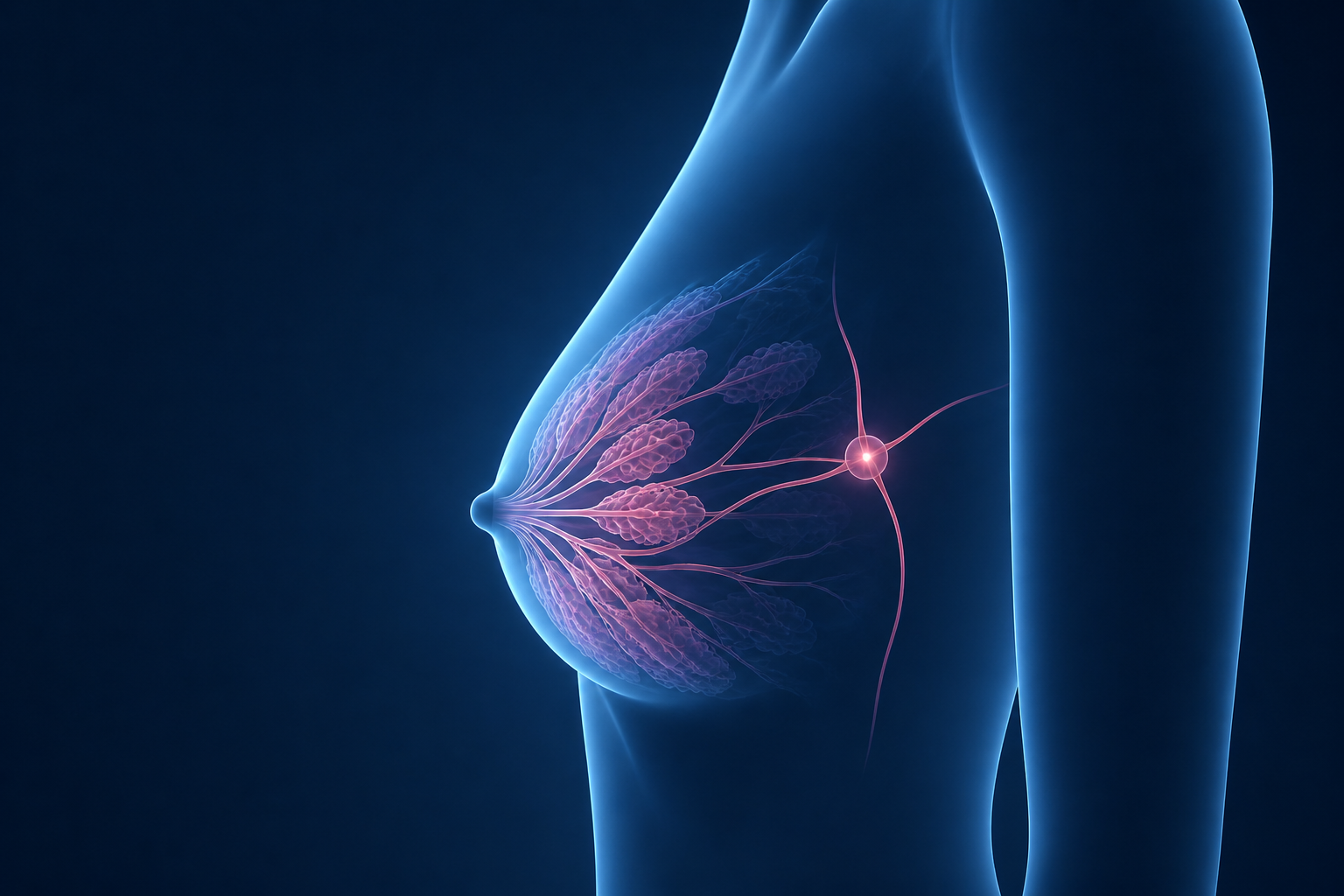
What Exactly Are Calcifications?
Calcifications are small deposits of calcium that form within breast tissue. They can occur in the ducts, lobules, blood vessels, skin, or surrounding tissue. They are not related to the calcium in your diet.
On a mammogram, they appear as tiny white dots or specks and are usually too small to be felt.
Causes of Calcifications
Most calcifications form because of normal aging or benign changes in breast tissue - not cancer. Knowing the common causes can help put a mammogram finding in perspective.
- Fibrocystic changes
- Cysts
- Fibroadenomas
- Aging changes
- Vascular calcifications
- Prior surgery or trauma
- Inflammation or infection
- DCIS (ductal carcinoma in situ)
Why This Can Feel Confusing
- Calcifications are very common and usually benign (non-cancerous), but some patterns require closer evaluation.
- The level of concern depends on the pattern and distribution, which can be difficult to interpret without imaging.
These resources explain what imaging findings mean in clear, simple terms, including what is important and what commonly happens next.
Browse Breast TopicsIs This Cancer?
Most calcifications are not cancer. However, specific patterns - particularly fine, irregular (pleomorphic) particles in a linear or segmental distribution - are the imaging signature of DCIS (ductal carcinoma in situ). DCIS is an early, non-invasive form of breast cancer confined to the milk ducts. It is highly treatable when found at this stage.
Calcifications account for approximately 55–60% of non-palpable breast cancers detected on mammography - which is why careful pattern analysis is so important.
Common Next Steps
Should I Be Concerned?
- Most calcifications are benign (non-cancerous) and are a common finding on mammograms.
- Radiologists look closely at the pattern and appearance of calcifications to decide if anything more needs to be done.
- If the pattern is not clearly benign or has changed over time, additional imaging - or sometimes a biopsy - may be recommended to better understand the finding.
- Comparing with prior mammograms is one of the most important ways to determine if calcifications are stable and benign.
Part of the UnderstandMyScan Education Platform
This is one example of the physician-developed patient education available through an UnderstandMyScan breast center partnership.
Explore More Sample Education Explore a PartnershipWritten and clinically reviewed by Sean Litherland, MD, board-certified diagnostic radiologist.
Last reviewed: Next scheduled review:
Sources
- Newell MS, Destounis SV, Leung JWT, et al. ACR BI-RADS® v2025 Manual. Reston, VA: American College of Radiology; 2025.