
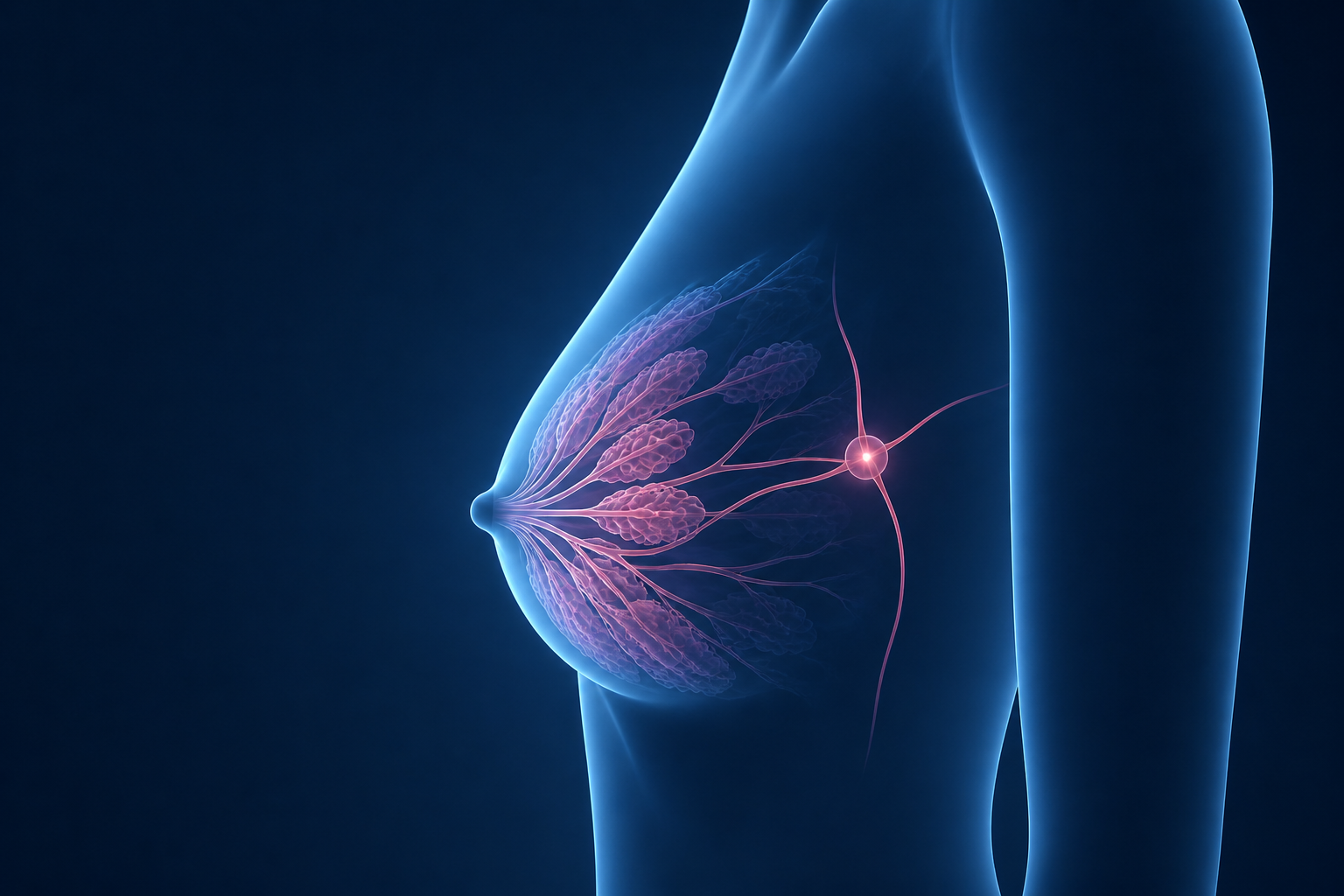
What Exactly Is Architectural Distortion?
Architectural distortion refers to a focal disruption of the normal breast tissue pattern: tissue appears to be pulled, tethered, or converging toward a central point, creating an abnormal star-like or sunburst appearance of fine radiating lines - without a definite mass at the center.
3D mammography (tomosynthesis) significantly improves detection and characterization of architectural distortion compared to standard 2D mammography. If you had a 2D screening mammogram, your callback exam will typically include tomosynthesis views.
Reassuring vs. Concerning Features
✓ Reassuring Features
- Located at a known prior procedure site
- Stable or decreasing on serial imaging
- No associated mass, suspicious calcifications, or lymph node changes
- Central lucent (fat-containing) area on tomosynthesis - classic for radial scar
⚠ Concerning Features
- New finding or increasing conspicuousness over time
- No prior procedure at that location
- Associated suspicious calcifications or lymph node changes
- Hypoechoic mass or shadowing on ultrasound
Why This Can Feel Confusing
- Architectural distortion can be subtle and may not form a clear mass, making it harder to recognize without imaging.
- It can have both benign and more serious causes, and reports often use technical terms that are difficult to interpret without context.
I review your imaging report and explain what these findings mean in clear, simple terms — so you understand what's important and what happens next.
Upload My ReportIs This Cancer?
Architectural distortion can have both benign and more serious causes.
Because it can sometimes be associated with breast cancer, radiologists usually recommend a biopsy when there is no clear benign explanation on imaging.
This approach helps ensure that anything important is not missed.
Common Next Steps
Should I Be Concerned?
- Architectural distortion that has a clear explanation - such as a prior biopsy or surgery at the same location - is generally not a cause for concern.
- A closer look is needed when the finding has no prior surgical explanation, is new compared to prior imaging, or persists on additional views.
- In most cases, this involves additional imaging. A biopsy is only recommended if the finding remains unclear or concerning after imaging.
Related Topics
Does your report mention architectural distortion? The context - prior surgery or not - and the BI-RADS category together determine urgency. A board-certified radiologist with subspecialty breast imaging experience can walk you through it step by step.
Get My Report Explained