
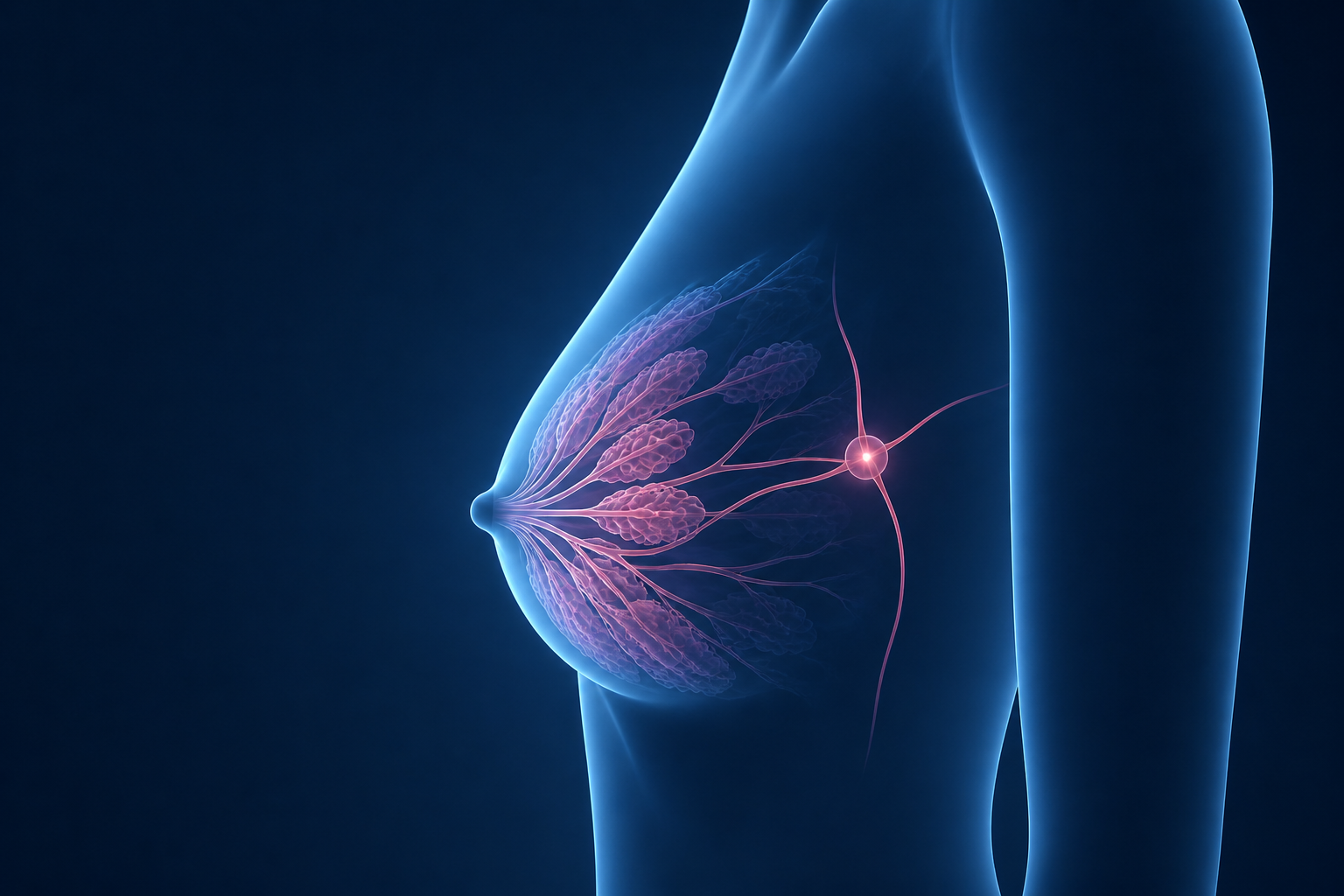
What Exactly Is a Radial Scar?
Despite the name, a radial scar is not a scar from injury or surgery. It is a benign growth of fibrous and glandular breast tissue that forms spontaneously. The central core is made of dense fibrous tissue, and from this center, ducts and lobules radiate outward like spokes on a wheel - creating the characteristic star-like or spiculated appearance on mammography.
Smaller lesions (less than 1 cm) are called radial scars. Larger or more complex lesions (greater than 1 cm, with multiple central cores) are called complex sclerosing lesions. These are almost always found incidentally on mammography or on a biopsy performed for a different reason.
⚠ Radiologists cannot reliably diagnose a radial scar from imaging alone. A radial scar and invasive breast cancer can be radiologically indistinguishable - their appearance overlaps completely. Biopsy is always required.
Imaging Features
Features Sometimes Seen with Radial Scar
- Architectural distortion with radiating spicules from a central point
- Central area of lucency on tomosynthesis
- Appearance that changes significantly between mammographic projections
Features Raising Suspicion for Cancer Over Radial Scar
- Associated mass at the center
- Associated suspicious calcifications
- Axillary lymph node abnormality
Upgrade Rates by Type
| Type | Upgrade Rate to Malignancy at Excision |
|---|---|
| Pure radial scar (no atypia) | ~7–10% |
| Radial scar with ADH | ~26% or higher |
| Radial scar with ALH or LCIS | Similar elevation |
| Complex sclerosing lesion (>1 cm) | Higher - larger size increases sampling failure risk |
What Happens Next
Core needle biopsy may undersample the lesion - adjacent DCIS or invasive cancer within the radiating ducts can be missed.
A small number of institutions manage select cases conservatively. This is an individualized decision.
Return to routine surveillance.
Occurs in approximately 7–26% of cases depending on presence of atypia.
When Should I Be Concerned?
Act promptly if:
- Surgical excision is recommended - do not delay it
- You have additional risk factors - a formal risk assessment is appropriate
- You have not received clear guidance on next steps from your surgical team
Related Topics
Does your biopsy report mention a radial scar or complex sclerosing lesion? The critical follow-up question is whether surgical excision is being recommended and whether any atypia was found on the core biopsy. A board-certified radiologist with subspecialty breast imaging experience can walk you through it step by step.
Get My Report Explained