
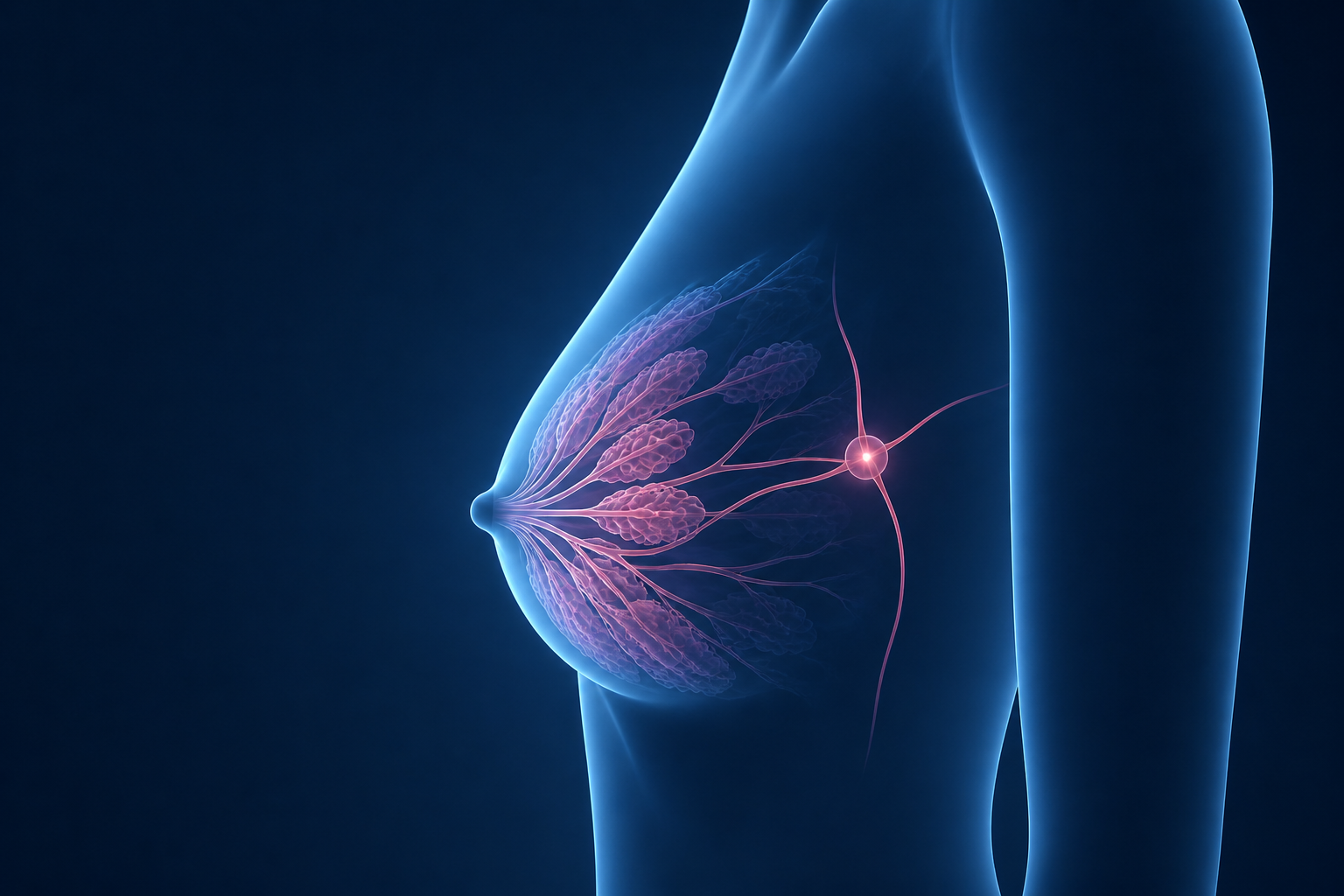
What Breast Tissue Is Made Of
Breast density is a measurement of how much glandular and fibrous tissue you have compared to fatty tissue, as seen on a mammogram. It is determined by a radiologist looking at your mammogram images and is completely separate from how your breasts feel or look.
Glandular Tissue
The milk-producing glands (lobules) and the ducts that carry milk to the nipple. Appears white on mammogram.
Fibrous Tissue
Supportive connective tissue that holds everything in place. Also appears white on mammogram.
Fatty Tissue
Fat that fills the spaces between glandular and fibrous tissue. Appears dark on mammogram - easy to see through.
Breast cancer also appears white on a mammogram. This is why density matters so much for screening - more on that in the other topics in this series.
The Four Density Categories (BI-RADS)
Breast density is classified using the BI-RADS system (Breast Imaging Reporting and Data System), developed by the American College of Radiology. There are four categories:
| Category | Label | What It Looks Like | How Common |
|---|---|---|---|
| A | Almost entirely fatty | Mostly dark / transparent | ~10% of women |
| B | Scattered fibroglandular density | Mostly dark with a few white areas | ~40% of women |
| C | Heterogeneously dense Dense | Mostly white - dense tissue throughout | ~40% of women |
| D | Extremely dense Dense | Almost entirely white | ~10% of women |
Categories C and D are considered "dense breasts." This means approximately half of all women who get mammograms have dense breasts.
The New Federal Notification Requirement
A new FDA rule under the Mammography Quality Standards Act (MQSA) requires every U.S. mammography facility to:
- Include an assessment of your breast density in your mammogram report
- Send you a notification letter that clearly states whether your breasts are "not dense" (Categories A or B) or "dense" (Categories C or D)
- Inform you of what dense breasts may mean for your screening
What Determines Your Density?
Breast density is largely determined by factors you cannot control:
Young women generally have denser breasts. Density naturally decreases as you get older and estrogen levels decline, particularly after menopause. However, density can remain high at any age.
Breast density is strongly hereditary - about 60% of the variation in breast density between women is explained by genetics. If your mother or sister has dense breasts, you are more likely to have them too.
Women taking hormone replacement therapy (HRT) - especially combined estrogen-progestogen therapy - tend to have higher breast density. Women who have had more pregnancies tend to have slightly lower density over time.
Women with lower body weight tend to have higher breast density proportionally, because they have less fatty tissue throughout the breast.
Tamoxifen (used to prevent and treat estrogen-receptor-positive breast cancer) can reduce breast density. Aromatase inhibitors also tend to reduce density.
When Should You Talk to Your Doctor?
How Doctors Assess Your Density
Your standard screening or diagnostic mammogram is taken
The radiologist evaluates the proportion of dense tissue to fatty tissue throughout both breasts and assigns a BI-RADS density category (A, B, C, or D)
Many modern mammography systems now use validated automated software (such as Volpara or Quantra) to provide an objective, quantitative density measurement alongside the radiologist's assessment
Your density category is documented in the mammogram report, and you receive a notification letter - since September 2024, this is a federal requirement at all U.S. mammography facilities
Your radiologist and referring physician consider your density in the context of your overall health history and risk factors when determining next steps
Important: Breast density can vary between mammograms and between facilities, because assessment has a subjective component. It can also change over time - typically decreasing gradually with age and after menopause.
What Happens Next
Frequently Asked Questions
My mammogram says I have dense breasts. Should I be alarmed?
No. Dense breasts are very common - about half of all women who have mammograms have them. Density is not a disease, a lump, or a sign that something is wrong right now. It is simply a description of your breast composition. What it does mean is that you and your doctor should have a conversation about your overall risk picture and whether supplemental screening makes sense for you.
Can I tell if I have dense breasts just by how they feel?
No. There is no relationship between how dense your breasts are and how they feel to the touch. Dense breasts do not feel harder, lumpier, or different in any way that you or a doctor could detect by physical exam. The only way to determine breast density is through a mammogram image reviewed by a radiologist. Many women are surprised to find they have dense breasts because they feel completely normal.
Will my breast density change over time?
Yes, it can. Breast density tends to decrease naturally as women get older, particularly after menopause. Stopping hormone replacement therapy can also reduce density. However, some women maintain higher density throughout their lives. Your density category may shift from one mammogram to the next, particularly if you change imaging facilities, since there is a subjective element to how radiologists assess density.
Looking for more breast imaging information? Explore physician-developed education about mammograms, callbacks, BI-RADS results, breast density, biopsies, pathology, and common breast imaging findings.
Breast centers can also explore a co-branded patient education partnership with UnderstandMyScan.
Explore Breast EducationWritten and clinically reviewed by Sean Litherland, MD, board-certified diagnostic radiologist.
Last reviewed: Next scheduled review:
Sources
- Newell MS, Destounis SV, Leung JWT, et al. ACR BI-RADS® v2025 Manual. Reston, VA: American College of Radiology; 2025.